FELICE ZIMMERN STOKES
INTERVIEW ARCHIVE
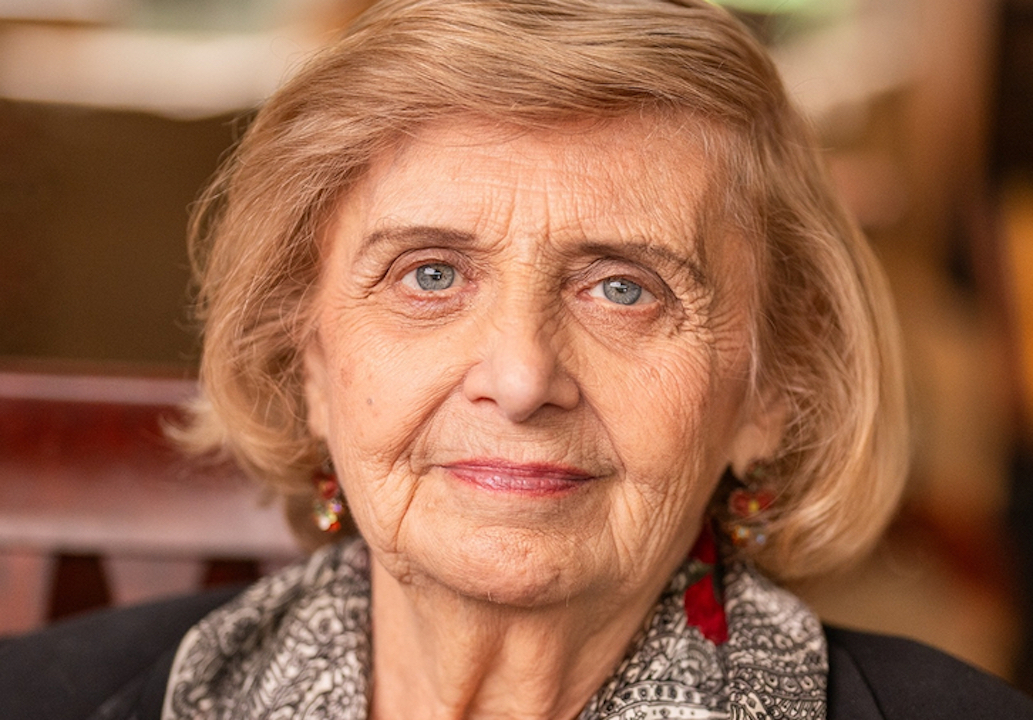
Felice Zimmern Stokes, Hidden Child of the Holocaust
Interviewed by David Bender
Total Running Time: 1 hour and 5 minutes
START TC: 00:00:00
PRODUCTION
Felice, if you'd just pardon my reach for a moment, I'm just going to slate in front of you. A and B camera common mark. Felice Zimmern, interview. Take one. Marker.
00:00:10
FELICE ZIMMERN STOKES
My last name is Stokes, though. I'm Felice Zimmern-Stokes.
00:00:14
INTERVIEWER
Zimmern-Stokes.
00:00:17
ON SCREEN TEXT
Felice Zimmern Stokes
A Hidden Child of the Holocaust
00:00:19
FELICE ZIMMERN STOKES
Right.
00:00:19
INTERVIEWER
Felice, thank you so much for doing this. So please, feel free to go ahead.
00:00:25
FELICE ZIMMERN STOKES
My name is Felice Zimmern-Stokes, and I see myself as a hidden child of the Holocaust. I was born in Walldürn, Germany on October 18th, 1939. In the house, I never went to a hospital to be born. I was born in the house where we lived. And then within a year on October 20th, 1940, we were all deported, all the Jews from that area, from the Palatinate region of Germany, were taken to Camp de Gurs, which is – which was located in the Pyrenees mountains between France and Spain. And we were there, I
00:01:25
FELICE ZIMMERN STOKES
was there till about 1941. And at that point, there was a Jewish organization called the Oeuvre de Secours aux Enfants, or in short, called the OSE, and they were able to come in and take some of the children out of the camp and taken us to a nursery called La Pouponniere, which is located in Limoges — was located in Limoge, France. And we were there for about a year and a half. When I say we, I mean, my sister Beate and I were taken there. She was two years older than I was. And that's how it started.
00:02:14
INTERVIEWER
Is that your first memory when you were about three or four years old?
00:02:19
FELICE ZIMMERN STOKES
I think my first memory was not at La Pouponniere, because I do not remember that time, but I remember living with the Patouxs. That was Juliette and Roger Patoux. They were non-Jews, and they took me in. And I thought that we were taken in because there was a man walking in the forest, and he just walked around and wanted to know from the different families, whether they could take a child in. But I found out later that it wasn't. It was from the OSE Group. It was a social worker who knew exactly where she was going, and she brought me to the Patouxs. It was like a farm. They raised grapes. And that's when I remember what was going on. She was a really lovely lady in her 60s and she was so interested in taking care of her son who was in his 20s. He used to be a salesman and he used to go around the countryside and used to come back home on the weekend and she would wash his clothes, prepare his meals. She was a real balabusta, as we say in Yiddish. She was a real lovely lady.
00:03:50
INTERVIEWER
But she treated you — she and her husband — treated you like their child?
00:03:54
FELICE ZIMMERN STOKES
Exactly, she treated me like her child, right? And she knew exactly what was going on and she hid all the jewelry underneath the earth, and she never went to sleep in a nightgown, she always was in her slip, ready to leave, ready to run away. And where she lived was a very small area, a very small, town village, really, it was maybe four or five homes. And nobody knew what was going on. And then we had to take, we would walk through a, like a narrow path and we would go into another town. She lived in [unknown] and then we went to visit friends and family in Vendeuvre.
00:04:54
INTERVIEWER
How much did you understand even then that there was a war going on?
00:04:59
FELICE ZIMMERN STOKES
I didn't understand any of it. I didn't know that I was Jewish. I used to go to the church with her, and she used to call me Felicee and I was Felicee Patoux. I was never Felice. I was Felicee Patoux and of course I spoke French and the people around her, you know, in the church, they took me as her child. They didn't really question. If they did, I didn't know anything about it. And I used to play with her neighbor's children. And I have pictures of that, you know, playing. And eventually, when I went back to visit, I recognized, I didn't recognize them, but I knew who they were.
00:05:52
INTERVIEWER
Was there this sense at all, even at such a young age, of being potentially in danger, or did they protect you from that knowledge?
00:06:04
FELICE ZIMMERN STOKES
No, during, when I was living there, I didn't know anything that was — there was anything wrong with me living there. I used to run around, play with the children next door, and I didn’t know there was anything wrong. I used to sometimes — sometimes when there were German, Le Boche we used to call them, they were like the, the German army — they might pass by, I used to wave to them. But I didn't know that there was anything wrong, and I didn't know anything about being Jewish or not Jewish. I just lived, you know... I was like a normal child; I didn't think that anything was wrong with me.
00:06:50
INTERVIEWER
You didn't realize you were a hidden child.
00:06:53
FELICE ZIMMERN STOKES
Right, I didn’t realize that I was hidden at all. At that point, I did not know what being hidden meant. You know, I thought that I was a girl going to church and I used to, you know, do this when I went to church because all the other children did it and that was my life.
00:07:20
INTERVIEWER
That changed when at some point the OSCE decided that as the war ended you needed to be placed in a Jewish setting. Do I understand that correctly?
00:07:36
FELICE ZIMMERN STOKES
Yes, it changed. In 1945, I think it was November 45, there was this little girl that came up the walk, and she looked very much like me, and I didn't like the fact that she was — she looked like me and she was gonna take my doll away. I had one doll; I used to call her my Yaya. And so, I was very afraid that she gonna take away my doll. But she came along on a garden path, and she was holding a pear, and she gave it to me, and I took it from her. And that was my sister. That was the first time that I remember seeing my sister, so that was interesting.
00:08:20
INTERVIEWER
And she was two years older than you.
00:08:23
FELICE ZIMMERN STOKES
She was two years older. So, then I think it was 1945. So, she had to be eight and I was six. Then right after that happened, within a month, they took us away from the Patoux and that was very, very upsetting because I felt so close to both of them, to Monsieur and Madame Patou, but I used to call them Mimi and Pépé, meaning... I thought it was mother, mommy, but it's not because in France they used to call them maman, but this is, I call her mimi, so that means grandma and grandpa. So, I was very upset that somebody came along and said, well, you have to leave. And they took us right away to a French orphanage. They called it Les Maisons d'Enfants. It took me two years to really even imagine what was going on because I didn't know anything that I was taken away from Madame Patoux, my Mimi. And I felt very close to her. And so that was very hard for me.
00:09:48
INTERVIEWER
Were you with your sister during this time?
00:09:50
FELICE ZIMMERN STOKES
Yeah, we were together. I was with my sister after we were taken away from the Patoux. It was the OSE took us from there because they knew it was very dangerous, and they wanted me to become Jewish and my sister to become Jewish as soon as possible.
00:10:13
INTERVIEWER
You went where? Where did they place you?
00:10:15
FELICE ZIMMERN STOKES
And then we were taken we were taking to d'Avray and then two years later we were taken to another orphanage called Taverni or Le Chateau de Voselle and that was the same an orphanage in 1946 where Elie Wiesel was taken when he was taken from his — the camp. And he lived there for, I think, two years, but I didn't know him then. I never met him then, but it was a wonderful orphanage. The children, we were all in the same boat and we were very much attached to one another, and I was very attached, very much attached to Elaine Ekezer. She was my monitrice or my counselor and she also had gone —
00:11:15
FELICE ZIMMERN STOKES
had been taken to Auschwitz, and she was there for a few years. She used to tell us such stories, and we loved listening to her stories. And she told us one story where there was this little girl, they were walking in the winter, and they asked the Germans, because there was a truck in front of us — or sorry, not in front of us, in front her — when they were marching. And they asked the Germans to take this little girl in the truck because she couldn't walk anymore. And they said, sure, of course. And they took her and then the moment she was in the truck, they shot her. And so, when we heard this story, we went, oh, that's such a great story, tell us some more. I mean, we were like... Whatever Elaine would tell us, we were so enthralled with what she was saying. That's the strangest thing.
00:12:19
INTERVIEWER
At that point, though, you had no knowledge of your own parents, where they were, what happened to them.
00:12:28
FELICE ZIMMERN STOKES
No, I didn't know anything about what had happened to my parents. I forget when I found out, but it wasn't while I was in the orphanage. I think I found that out later, that they had been taken from Rivesaltes, which was a holding place to Drancy and then eventually to Auschwitz and they were taken there on the convoy 40 on November 4th, 1942.
00:13:06
INTERVIEWER
Probably is, if I've read it right, you were in your 20s, perhaps, when you read that book, and you discovered David and Lydia, your parents, and what happened to them.
00:13:23
FELICE ZIMMERN STOKES
Right. I went to visit, I went to Paris, and I went to visit Elen Ekezer, my former counselor who I was with at Taverni. And I told her that I wanted to go back to Germany, to where I was born. And then she told me, you also have to look through this book, The Memorial of the Jews in France from 1942 to 1944, which was written by Serge Klarsfeld. And in this book, he put every single person that had gone through France or through the trains to Auschwitz. There were the names where they were born, when they were born, and when they were deported and the dates. And that's how I found out. And I was very... it's so strange, but I was so excited to finally find the names of the names of my parents because I had never found them. I thought that maybe they were still alive somehow.
00:14:39
INTERVIEWER
You knew their names, you knew what the names were.
00:14:43
FELICE ZIMMERN STOKES
Right.
00:14:44
INTERVIEWER
So, you knew you were looking for when...
00:14:46
FELICE ZIMMERN STOKES
Right, because when we came to America in 1951, to my aunt — we thought we were gonna live with my aunt and uncle, Julius and Lina Zimmern. He was my father's brother, and it took them five years to decide whether they were gonna take us in. And we thought we were going to be taken in by them. So, we came on the boat, SS Washington at the end of January 1951. I think we left on January 24, and we arrived on January 31, 1951
00:15:27
INTERVIEWER
So, you were about 12 years old, you and your sister.
00:15:29
FELICE ZIMMERN STOKES
No, I was 10 and a half. 10 and half. Yeah, and my sister was 12 and a half. And so, we find out, we come off the, we come off the boat — I mean the, you know, we're walking down — and all of a sudden, we find out that no, we were not gonna live with my aunt and uncle, so my sister started to cry. She was so upset, and I see her cry, so I started to cry. And there were three social workers waiting for us. And they didn't speak French, and we didn't speak English, so that was another problem. It was very hard. That was the worst part of coming here.
00:16:11
INTERVIEWER
If I may, why did your father's brother, why did they not take you in immediately? What happened?
00:16:18
FELICE ZIMMERN STOKES
Well, what happened was that they had a son, who was, I think, 17 at the time, they all — she had a — my aunt had a brother, my aunt had a mother, and they all lived in the same apartment, so there was no room. But the OSE did not want to leave us alone and they didn't want to separate us, so they had to, so they knew that we were not gonna live in Buffalo — that's where they lived— so we came to Newark in a home. It was like a, it wasn't an orphanage, but it was a home for Jewish children who had problems with their parents.
00:17:05
INTERVIEWER
So suddenly, you're not with family in America. You don't speak English. In the home that you were placed, did they help you learn English? How did that…?
00:17:19
FELICE ZIMMERN STOKES
Well, in the home we were placed, they did help us speak English, but they didn't speak French, so a week or two later, we were sent to a school, Bergen Street School. So, I was put back in the fourth grade, and my sister was also with me. There was one teacher who spoke French, Ms. Zinn, that was her name, so we went to her classroom. And the first thing the kids did, we went into the cloakroom, and they wanted us to say, Polly wants a cracker. And we didn't know what that was until later we found out. And the kids were teaching us how to read English and how to speak. So that's how we learned English very fast within two weeks of coming to France— coming to Newark, New Jersey.
00:18:20
INTERVIEWER
And this was in a Jewish setting, the home that you were in.
00:18:24
FELICE ZIMMERN STOKES
Yes, it was a Jewish setting, the home we were in. From then on, after we left France, we were only connected with the Jewish setting. It was the Jewish Child Care Association were the ones that were in charge of us.
00:18:41
INTERVIEWER
And after having been raised by the Patouxs, a family that was not Jewish, this was your discovery of your identity as a Jewish person.
00:18:56
FELICE ZIMMERN STOKES
Yes.
00:18:57
INTERVIEWER
Was in those homes and with those people and other children. When did you come to understand what had happened during the war and prior to the war? When did you come to understand that there had been a holocaust?
00:19:21
FELICE ZIMMERN STOKES
When did I come to understand that there had been a holocaust? I think it was, it took me a while to figure out what was going on and I had a social worker who I used to see, I think once a week, from the Jewish Child Care Association and I think she spoke to me, and I spoke to her. I knew there was something strange that my sister and I had been in an orphanage in France. And so, they slowly told me about it. And my sister and I used to talk to each other at the home. And so... And there were a lot of children living with us, you know, we were like, the girls group were in one group — were in one area, and the boys were in another area. I knew that there was something different, but I was much
00:20:21
FELICE ZIMMERN STOKES
more amenable to things going on. I was in a good frame of mind. It was my sister who had a harder time with what was going on, and there was this woman, Margot, who was a counselor, and she spoke French, so we used to be with her for a while, although she was with the boys, she wasn't with the girls. There was another counselor whose name was Martha, really lovely people. It was really nice there. And then during the summer, they suggested that I go to a camp, to a Y camp. So, I said, sure, I'll go. So, I went to camp. My sister didn't want to go. So, I was there for the summer, for three weeks, I think. And I really enjoyed it. I was in a — we were in a performing group.
00:21:21
INTERVIEWER
This is the YMCA?
00:21:22
FELICE ZIMMERN STOKES
No, no. Y-W-H-A.
00:21:26
INTERVIEWER
Y-W-H-A.
00:21:27
FELICE ZIMMERN STOKES
It was only Jewish...
00:21:27
INTERVIEWER
...Hebrew Association. Let me ask you why you think your sister had a tougher time adjusting to it than you did.
00:21:38
FELICE ZIMMERN STOKES
I think that my sister, because she was older, so she, I think, understood more what had gone on, I think might have been the reason. But they put me in the same group as my sister when I was in the orphanage in France because they felt that it would be easier for both of us to be in the group. But she wanted to be her own self, she had her own friends, so it was hard for me, but I... You know, I said, okay, that's all right. You know and I went on by myself, I did my own thing.
00:22:16
INTERVIEWER
As you become a teenager, Felice, and we're now in the 50s, one of the things about America that always struck me is that we had fought so hard to defeat Nazism, yet there was anti-Semitism in America. Did you experience any of that?
00:22:39
FELICE ZIMMERN STOKES
No, I didn't really experience any of it. I don't know why, but I didn't because a year and a half later after I left the home because they were disbanding it, they sent me to a foster home by myself. I really didn't want to be with my sister because I felt by then I was 12 and she wanted to be on her own and I wanted be to on my own. So, I went to live with one set of foster parents. But I didn't get along there. So, then I told my social worker, I want my own room because then before that, I lived with this girl, Claire, and she lived — she was on the bottom bunk, and I was on a top bunk, and we didn't get along very much. And so, I said to the social worker I want my own home, I want a home,
00:23:37
FELICE ZIMMERN STOKES
and I want, I think I said something else, you know, I want... I didn't really get along with the foster parents, so I said I wanted a set of parents that I could get along with. So, they found this couple, Toby and Mary Geller in Linden, New Jersey, and they had two boys, seven and nine at the time, and I was 14, I was just starting high school, so I went to live in Liden, New Jersey. So that, I got along very well with them, and they were a very caring family.
00:24:18
INTERVIEWER
Was this a time, as a teenager now, that you began to understand that you had been in France as a hidden child? Or when did that...?
00:24:28
FELICE ZIMMERN STOKES
No, I don't remember being a hidden child until much later, until I had graduated high school, until I started to go to... I was invited because I was a... At that point, I still was considered a survivor, and I was invited to different conferences. And then I found out about hidden children, and I think it was in 1991 they had a conference in New York at the Marriott Hotel, and they were going to be maybe five — I thought they were going to 500 people, and there were 1500. So that's when I really connected with being a hidden child.
00:25:22
INTERVIEWER
You were nervous about going to that, right?
00:25:24
FELICE ZIMMERN STOKES
Yes, I was very nervous about going there because I didn't want to go by myself. So, I asked — I contacted one of the girls that I had met before and I said, would you mind if we went in together? Because I was always very anxious about going in anywhere by myself, so she said no. So, we went and then I ran into different people that I recognized from folk dancing because I used to do a lot of folk dancing, so I recognize them. And that was a wonderful experience. I was there two days, you know.
00:26:01
INTERVIEWER
A question that comes to mind is the distinction between being a hidden child and a survivor. Did you ever have what has been described as survivor's guilt because you did not go through what people who were actually in camps went through? Was that difficult?
00:26:23
FELICE ZIMMERN STOKES
I did. I did, I really... I did have, what did you say, I had a...
00:26:31
INTERVIEWER Survivor's guilt.
00:26:31
FELICE ZIMMERN STOKES
Survivor's guilt. I had survivor's guilt because I felt that I had nothing to show for it. So, I said I wish I'd had a number on my arm so that people would understand that I also had suffered even though I was a child. And I felt that why did my parents, why were they, you know, killed? For what reason? Because they were just Jews. And so that also bothered me a lot. But that was further on. And what I must say is that I started to go into therapy, and I think that's what really helped me to provide me with understanding and what really happened, and I shouldn't feel so sorry that it happened to me. And I had nothing to do with it. And so that's when it really helped me.
00:27:32
INTERVIEWER
And I know one of the things that you've spent your life now doing, much of your life, is sharing that experience as a hidden child, but sharing your knowledge with people who know nothing about it, particularly younger people. The more you've been able to do that, has that had a sense of achievement of something that you'd done where you know you've made a difference in people's lives?
00:27:59
FELICE ZIMMERN STOKES
Yeah, I think that talking about it to different — like I've spoken to the high school in Teaneck where I live, I've spoken to a group of people and just recently I've spoken to people in Corning, New York. There were about over 450 people and that really helped me. They really thanked me for talking about, even though I get very anxious about it until I get into it. That's why I like the idea of someone asking me the question and I'm able to respond.
00:28:43
INTERVIEWER
This is a conversation that is very meaningful to me. You mentioned Elie Wiesel. I said that one of the things that was the great privilege of my life was meeting him and speaking with him. And what he told me is something that I trust you discovered, is that any time you speak to someone, even if you have no actual memory of what happened to you, but you know about it and your family was lost to because of the Holocaust, you make it real for other people and you are a witness to it. And it is, for him, bearing witness and then every time you tell someone else, they're a witness now, you pass it on. Do you relate to that?
00:29:32
FELICE ZIMMERN STOKES
I do and I forgot to talk to you about the fact that I did go back to Germany, and they absolutely could not believe that I was alive because there was only four or five Jewish families in the town of Walldürn. If I may, I want to tell you about it. I went to somebody's, to a — I went to speak to someone and as it turns out he spoke English, and I said I would like to rent a bike because I was born here. So, he asked me for my name and at the time I was just Felice Zimmern. So, I told him that and he said to me, well you go down this street, and you knock on these people's door and show them your passport. I said okay, so I went down that street, and I knocked on the door
00:30:32
FELICE ZIMMERN STOKES
and I showed this woman my passport and she almost passed out because she thought I was my sister because her daughter and my sister had played together when they were three. So, she kept saying, Beate, Beate. I said, no, no I'm her sister, Felice. And she absolutely could not believe and she started calling everybody there and telling them, please, look who's here. And they wouldn't let me — I had to eat with them, and I had to stay with them. I couldn't stay in the hotel. And I said I wanted to go visit the cemetery and they took me there. There was this woman who was the wife of the principal of the school, and she said she used to be Jewish, but she decided not to be Jewish because of what happened to the Jews.
00:31:30
FELICE ZIMMERN STOKES
She decided to be my guide, and she took me by her hand and showed me different people. And it was amazing. I went back to where I was born, the actual house, and they said to me, are you gonna come back? Are you gonna visit us again? I said, oh, I don't think so. I don't know, I said, I'm not sure. That's the way I put it.
00:31:53
INTERVIEWER
Felice, you met these people, they survived. And did they tell you what it was like for them to live through that?
00:32:02
FELICE ZIMMERN STOKES
No, no, when I went — no they did — these were not Jews. These were non-Jews who lived in the town. But they were not, they were — so there was no problem for them.
00:32:14
INTERVIEWER
But they survived the war.
00:32:15
FELICE ZIMMERN STOKES
They survived the War.
00:32:16
INTERVIEWER
And did they tell you about, they or their, at this point, perhaps, well, no, these were people who knew your sister — did they describe what the conditions were like when the Jews were taken away? Were they able to tell you the stories you didn't know?
00:32:33
FELICE ZIMMERN STOKES
All they were saying, they didn't tell me exactly, but all they kept saying was that we had nothing to do with them with this. Your parents were very good people. I used to deliver the milk to them. I used to do this with them. That's all they said. Basically, they said we couldn't help. That's what they said.
00:32:57
INTERVIEWER
Did they feel bad? Did they feel they were aware of what was going on?
00:33:03
FELICE ZIMMERN STOKES
Yes, they were aware. They might have felt a little bit, I don't know if embarrassed is the right word. They might've felt terrible about it, maybe, but...
00:33:18
INTERVIEWER
Because these were their friends, their daughter played with your sister. This was...
00:33:25
FELICE ZIMMERN STOKES
Yeah... I can't, there must be a word, they were — it's not embarrassed, they felt terrible about it, maybe.
00:33:32
INTERVIEWER
Guilt?
00:33:33
FELICE ZIMMERN STOKES
Guilt, maybe, they might have felt guilt.
00:33:37
INTERVIEWER
Did, and of course we know a lot of non-Jewish people in Germany and other places, certainly obviously in France, risk their lives to try and help and hide Jews or help them out. In the descriptions that you would hear when you went back to your town and then, as I understand it, about nine years ago, you went to Auschwitz.
00:34:05
FELICE ZIMMERN STOKES
I did. I went to Auschwitz with the March of the Living, and they asked me to be in a certain bus whereas the teenagers would sit in the back, and the adults would be in the front and they ask me to speak to the teenagers about what had happened to me. That was a very, very painful time to be in Auschwitz because I went by myself which in retrospect I should have gone with a friend or... But it was very painful because, of course, I knew that my parents had been there. It was very hard, very hard.
00:34:45
INTERVIEWER
You, as I said before, you've spent much of your adult life, I know that you worked as an executive secretary for a long time at the Memorial Foundation for Jewish Culture. So, you've immersed yourself in Judaism and Jewish culture, even though you weren't raised that way as a young girl. Has that been part of your process of dealing with having been a hidden child, is learning more about culture and Jewish culture?
00:35:23
FELICE ZIMMERN STOKES
Yes, since until I was about eight and a half when I went to the second home and I found out that I was Jewish and they taught me Hebrew and they told me how to daven, how to pray, and they tell me that I'm Jewish. I never knew that I am Jewish. So then afterwards, that's all I wanted to do is be a part of the Jewish group, the Jewish faith. I even went to college, to Stern College, which was the women's division of Yeshiva University. I went there because, of course, because I got a grant, but not only that, because I knew that my parents had been Orthodox, so I wanted to learn more about that part of Judaism. And there it was, it was a good feeling. People were very much in tune with me. They knew about my background, I spoke a little bit about it, but not too much, although when I ran into people, they said that I did speak about it a little. Even in high school, someone told me that I spoke about it which I don't remember in Linden High School.
00:36:42
INTERVIEWER
You were also, forgive me, you were also very moved by, as I was, the first time I went to the Holocaust Museum. Talk to me about, did you — it's a process that I know must be really strange in a way because you're learning about something that happened to your parents and by extension to you, but you didn't learn about it when it happened you learned about it after the fact. What was it like going to the holocaust museum learning things and seeing things so vividly?
00:37:24
FELICE ZIMMERN STOKES
When someone told me about the Holocaust Museum, it was the husband of a very good friend of mine, who actually we roomed together at Stern, and he worked for the American Jewish Committee, and he'd worked for The Museum in Washington. So, he said, you know, I think you should be in touch with them and tell them who you are and maybe you can connect with them. So that's basically what happened. I donated some money because I wanted my parents' names to be on the wall. I wanted them to be part of it. And then I became very close to quite a few people from there, and every year I go there. And we meet and we talk about it. When I joined my synagogue, the congregation Beth Shalom, at first it was a little hard, but then I connected
00:38:23
FELICE ZIMMERN STOKES
and they asked me whether I would speak to the children. So, these children were from eight to 10 or 11, and they were wonderful. Usually, I would hold on to a paper, and I would read to them what went on, but not with them, I just spoke to them so naturally and they asked me questions, and it was so wonderful. It really opened my head... that I was really connected with these children. So, there's no way that I would ever leave the Jewish religion. No, that was my... I was connected to that.
00:39:04
INTERVIEWER
But the connection was more than Judaism. The connection was, again, using Elie Wiesel's phrase, bearing witness.
00:39:13
FELICE ZIMMERN STOKES
The connection was bearing witness, Elie Wiesel. I met him at one of the conferences and I tried to speak to him in French, but he wouldn't speak to me in French. And there was this other girl with me, she was from Canada, and we tried to speak to him. It was hard to speak to him. For me, it was hard to speak to him, but he was a good man, very good man.
00:39:43
INTERVIEWER
A remarkable man, but the notion that anyone who has been a hidden child survivor of a camp, the only thing that is... I wonder if you consider almost an obligation to share these stories, your memories, your perspective while you can, as you have through your life, so that people realize that it did happen.
00:40:20
FELICE ZIMMERN STOKES
Yeah, it is an obligation, yes, that's a very good word. I also have spoken a few times, three times, "Names, Not Numbers," where the children, they're like teenagers, 13-year-olds from the Jewish schools, day schools, and they ask you different questions and they do a video and then afterwards we all sit together and we watch it. And that's a very good thing. And they've asked me to speak again. And I said, you know, I'm gonna say the same thing, it's not different. They said, yes, yes, but we want you to speak. So maybe I'll speak again.
00:40:59
INTERVIEWER
And "Names, Not Numbers," what does that mean to you?
00:41:05
FELICE ZIMMERN STOKES
It means that even though names not numbers means that even though a lot of the victims in Auschwitz had to have a number on their arms and they all talk to them as numbers, they didn't talk to what their names were. So, names is more important than numbers.
00:41:33
INTERVIEWER
Does your sister share that sense of obligation?
00:41:36
FELICE ZIMMERN STOKES
No, she doesn't talk about it. It could be that she had her children very young, so she was very, very busy with them. And then when my nephew, David, was bar mitzvah-ed, that's when I came on Friday evening and I start speaking to him about it, that's why he became interested, my nephew. And Gail and Jennifer is also very interested.
00:42:02
INTERVIEWER
To the children, basically your sister's grandchildren, do they, are they aware?
00:42:11
FELICE ZIMMERN STOKES
I don't know if they're — they might be, but not as much as my niece Jennifer's daughter, Emma. She just had a bar mitzvah, and it was written in her program about my parents. So, Emma knows about it. Oh, and then my — Gail's daughter Maya, she also knows about it, she's just, she's in college now.
00:42:40
INTERVIEWER
Felice, do you think there's any danger now, it's so many years on, of people both forgetting and denying that it happened?
00:42:55
FELICE ZIMMERN STOKES
I definitely think there may be. I definitely think there may, so that's why we really need to talk about it. Even though afterwards sometimes it really is painful for me to deal with it, or beforehand when I get nervous about it, but let me tell you my sister's grandchildren: Aaron, Jessica, Sarah and Sam. Yay, I remembered their names.
00:43:24
INTERVIEWER
And they are memorialized. What I think is so important about what you've done with your life and as a hidden child in the concept... So many of us grew up knowing about Anne Frank and literally hidden physically, she couldn't go out and play with other kids. She was hidden. Was that something, the story of Anne Frank, was that something you knew about growing up?
00:44:01
FELICE ZIMMERN STOKES
Was the fact about Anne Frank's story? No, I never knew about Anne Frank's story until much later.
00:44:06
INTERVIEWER
And when you read it and learned of her, do you remember how you felt about understanding what Anne Frank would have gone through being physically hidden away?
00:44:24
FELICE ZIMMERN STOKES
Yeah, I did understand. I saw the play. That was very hard to see, the play of Anne Frank. I could understand it and it was so painful to hear that they were found out and that they were taken away, she and her brother and all the family.
00:44:50
INTERVIEWER
And although you didn't know it at the time, that could have happened to you.
00:44:54
FELICE ZIMMERN STOKES
It could have, yeah.
00:44:58
INTERVIEWER
What is it you're most proud of that you've done, if you think of it as a personal accomplishment or achievement, and what do you still hope to do?
00:45:09
FELICE ZIMMERN STOKES
What is my personal achievement? Well, I guess one of the personal achievements is to talk about it. At the beginning, it was very hard for me to talk about it, but I think that's my personal achievement, to connect with others and to tell them about it and to remind them that it did happen. And it wasn't something that somebody made up. It did happen, and only because we were Jews, and they were so scared of us. I don't know why, but I think that was the hardest part. It was very hard for me at the very beginning, living in the... You know, when I went from one thing to another, from this home to this home, living in this orphanage, coming to America, we were all really on our own. We were really not connected with anyone, with any family, and that was the hardest part, to really connect with anyone. That was the hardest part.
00:46:21
INTERVIEWER
And Felice, what you've done as a volunteer, I know you've been working in Teaneck with people who've survived not just the trauma of the Holocaust, but other kinds of trauma. So, is that work that's been important to you is helping to use your own experience to?
00:46:40
FELICE ZIMMERN STOKES
The work that I do at the hospital, Holy Name Hospital, is not really the same, because I really don't deal with the patients. I deal with patients who need to go from point A to point B, so I'm not connected to that at all, so that's something else. I really enjoy being a part of the synagogue and being a part of people there and the children there. I really connected. The only sad part is that I never knew my parents. I never know what kind of people they were. I'm glad that I had Madame Patoux and some of the other people that were in my life and of course my social workers and my therapists, they really helped me a lot.
00:47:35
INTERVIEWER
There's a quote of yours, and again it comes from your... Tell me before I read the quote about The Blue Card.
00:47:47
FELICE ZIMMERN STOKES
Oh, that's an organization.
00:47:48
INTERVIEWER
Right. Tell me about what they do, do you know?
00:47:51
FELICE ZIMMERN STOKES No, I really don't know.
00:47:53
INTERVIEWER
As I read it, they're working to identify the Holocaust survivors still in the United States. It's a smaller and smaller number, but perhaps as many as 80,000 in the United States now.
00:48:08
FELICE ZIMMERN STOKES
Where are you reading that?
00:48:09
INTERVIEWER
I'm reading it online. And apparently a good number, stunning to me to think about, a lot of survivors are living in...
00:48:24
FELICE ZIMMERN STOKES
In poverty.
00:48:25
INTERVIEWER
In poverty, yes.
00:48:26
FELICE ZIMMERN STOKES
Yeah, that's what I said.
00:48:28
INTERVIEWER
Is that something you were aware of?
00:48:34
FELICE ZIMMERN STOKES
Yeah, that's why I give a lot of donations to it.
00:48:39
INTERVIEWER
It's horrific to think about. The number I'm reading here is as many as 30% of Holocaust survivors.
00:48:45
FELICE ZIMMERN STOKES
There's another one, Dorot. D-O-R-O-T. That's another, yeah, I do give a lot of donations. I didn't tell you about the letters that we found that my parents, when they were in Camp de Gurs, wrote to my uncle, Julius, in Buffalo, begging him to help them to try to get them out the camp. And there were about 40 letters, and I got them when my niece was going to college in Buffalo, and my uncle and aunt gave — actually my aunt gave the letters to her, and I had them translated. And I have some of them here.
00:49:31
INTERVIEWER
Please, share something. This is your connection to your parents. These are their words.
00:49:42
FELICE ZIMMERN STOKES
This is from my uncle Hugo, October 30th, 1940. My uncle Hugo is the brother of my father. "You will be astonished, but eight days ago we had to leave Mannheim with one hour's notice, with two pieces of luggage. It was dreadful. Three nights of rail journey without food. All the Jews of Baden-Pfalz were expelled. Others will follow, no doubt. France was not prepared for this mass of people, and therefore there is a lack of everything. You cannot imagine what it is. The French are very polite and make every effort to lighten the people's fate. But because of the war, they themselves are limited in everything. We are in wooden barracks without heating, and the barracks are very primitive. Men and women are separate. David and family and Leopold are also in my block. Today I could see Hermine..." I believe she was my aunt and the wife of Uncle Hugo, "... for the first time in eight days, for two minutes, I could not yet speak with Lydia..." that was my mother, "...and the children."
00:51:05
INTERVIEWER
Do you have any letters from your father, David?
00:51:08
FELICE ZIMMERN STOKES
Yes, this next one. This is from my father, David, on November 4, 1940. "About two weeks ago, all of us left for a camp in the south of France. This was a great surprise, and we could only take with us the most essential things. We had to leave everything home. Sad but true. Dear Lydia and the dear children are here also. The French make every effort to feed us, but nevertheless, we have to miss certain things. We could not have dreamt of such a thing of all our lives, that we have to leave Germany in such a way with nothing."
00:51:51
INTERVIEWER
You said there were 40 letters, approximately.
00:51:56
FELICE ZIMMERN STOKES
Yeah. Oh, this is from my mother, April 16th, 1941. "Many thanks for the packages you advised us of, but they have not yet arrived. The dear children have been in Limoges for three months. They are well and well taken care of but missing them is terrible. They write positively, but we are not with them. I would be happiest of women if we had the dear children with us again."
00:52:25
INTERVIEWER
So, you have the words of your mother and father, but only, how did you get the letters?
00:52:30
FELICE ZIMMERN STOKES
So, I got the letters from when my niece was in Buffalo, the college, and my niece Gail went to visit her and my aunt gave these letters to her in German, and I had them translated from a good friend of mine who spoke perfect German. And this is from my father. "I only weigh..." this is June 12th, 1942. "...I only weigh 94 pounds. Unfortunately, one has to suppose that the end of the war is still far from over and that we will have to spend another winter here and many will. Therefore, we'll have to go to their graves." Oh, sorry. "And many will, therefore, will have go to the graves. Our dear children are well so far. Dear Beate was moved out May 1st. She is one hour from Limoges with a lady who has a child of the same age and wrote us very kindly. The home, La Pouponnière, can keep children only till the age of four. Dear Felice was all right." Oh, that's what I found out about Beate. I didn't even know.
00:53:49
INTERVIEWER
Felice, these letters are remarkable. Please continue.
00:53:52
FELICE ZIMMERN STOKES
Yeah, they are remarkable. The following letter dated August 16th, 1942, from Montlouis is the last letter that my uncle Julius, who was living in Buffalo, received. As I mentioned earlier, it was ironic because I learned through the Klarsfeld book that my Uncle Hugo had been deported to Auschwitz on August 12th, 1942. And my uncle Leopold was deported on August 28th, 26, 1942, 10 days after he wrote the letter. This is from Uncle Leopld. "You will be astonished to have a sign from me. For three months, I have been here in Montlouis, Pyrénées, Orientales with a work company and the work is very hard. Meanwhile, to my regret, I had not heard from Gurs. I assume that Hugo and David moved. Where to? I do not know
00:54:52
FELICE ZIMMERN STOKES
whether I shall ever find out. This is very sad, and you will surely have read about it. Sad, but true. I therefore had to experience troubling days and hours again. And we are all very upset. For the time being, we are staying here. We do not know what will happen. We only live in the hope that we will all meet again after the war, maybe as quickly as possible. This is the hope of many. At this very moment, I received a return letter from Gurs with a notation left, quote unquote, which I had addressed to Hugo. With the same mail, I receive a letter from David in which he informs me that he did not leave Gurs because he has children below the age of five, but that Hugo and Hermine, to his regret, had to leave.
00:55:53
FELICE ZIMMERN STOKES
He does not know where to, probably P, quote unquote..." The letter P was obviously for Poland. Surprisingly, this sentence was not censored. A lot of the part of the letters were censored, but this part was not.
00:56:12
INTERVIEWER
It's extraordinary to me that even letters could get in and out.
00:56:16
FELICE ZIMMERN STOKES
It was extraordinary. The dates.
00:56:17
INTERVIEWER
I understand that you recently went to Yad Vashem, tell me about the experience of Yad Vashem.
00:56:30
FELICE ZIMMERN STOKES
Oh, I've gone to Yad Vashem quite a few times. You mean in Israel?
00:56:33
INTERVIEWER
Yes.
00:56:35
FELICE ZIMMERN STOKES
Yes. I went to Yad Vashem. Well, the last time I went, it was with Yad Vashem. They had a tour. And I went with a good friend of mine, Eileen, who used to work for Yad Vashem, Eileen Leisner. We took a tour, and Yad Vashem is amazing. It's got everything that ever happened. During the war, during the Holocaust. And that was very painful, but very, very good for me to go.
00:57:07
INTERVIEWER
And your parents' names are there?
00:57:11
FELICE ZIMMERN STOKES
No, my parents' names were not there, but later on I found out that there was a list of names which the – which Yad Vashem put together of every single person that had gone through the war. And like you've heard of six million Jews, well they were able to, to get together I think, 4,900,000, so it's not there yet, but we'll see. And then within that group, I was able to go to the UN this past February and I found 12 names with the names of Zimmern, so we were connected as somehow cousins, second cousin, third cousin... And I found out that I had a cousin who now lives near Boston, and her father and my father also were connected, so that was very exciting to find any names.
00:58:18
INTERVIEWER
The quote I wanted to read you is something you said about the work that you've been doing at the hospital. You said that so many of the young nurses and medical residents I've met at the Hospital know very little about the Holocaust, except as a historical note in a book about World War II. So, the more those who live through it can still speak up about it, the better.
00:58:50
FELICE ZIMMERN STOKES
Yeah, it is, and the people that I, now that I work directly with, I spoke about it a little bit because they wanted to know, so I spoke to, I don't like to, sometimes I don’t like to sort of put myself out and say something about the Holocaust because sometimes I feel that people really don’t want to hear about it, so, I don’t talk about it. But if they, if they look as if they’re really interested, they want to know something so then I speak about it, and so quite a few of them are interested, so I spoke about it.
00:59:25
INTERVIEWER
Let me ask you about your feelings now. You strike me as someone who is extremely positive and looking forward and looking toward helping other people. I don't think I'm mistaken in saying that. Is that your sense of purpose in life is to be of service and to help others?
00:59:50
FELICE ZIMMERN STOKES
I think you're right. I think my sense of living through life is helping others or talking to others, or caring, or being very interested in others. As a matter of fact, I thought when I was in college that I wanna go into social work. And then I realized that I, before going into social work, I really had to get myself together to find out what was wrong or what I needed to do for myself before I could help others. So that's why I did go into therapy.
01:00:27
INTERVIEWER
A lot of things in life give us pleasure. One thing that seems consistent is music. Do you listen to music?
01:00:36
FELICE ZIMMERN STOKES
I do, I love classical music, Bach, Beethoven. And I also love, I used to love to do folk dancing. I did a lot of folk dancing, I performed folk dancing when I was in my mid-30s. I really like music, you know, a lot.
01:00:58
INTERVIEWER
And it gives you joy?
01:00:59
FELICE ZIMMERN STOKES
It gives me pleasure, yeah.
01:01:02
INTERVIEWER
Do you see anything that gives you concern now, here or anywhere in the world, that we might have forgotten to the point where it could happen again?
01:01:15
FELICE ZIMMERN STOKES
Unfortunately, ten years ago I probably would have said it doesn't worry me that something may happen again in the world, but now unfortunately there are things, you know, what's going on maybe in the United States and maybe in Europe that could happen again. It was very hard for me to go back to Germany and visit. Besides the fact, besides when I did go back where I was born, but when I went to Berlin, I took a trip because this was part of the March of the Living — No, I'm sorry, this was — I went on a cruise, and this was a part of it. So that was a little hard, to say the least. I could feel something in Germany. There was something there.
01:02:14
INTERVIEWER
Overall, as we sit here today, are you hopeful that, particularly among young people, there will be a chance to create a better world. Do you hope for that?
01:02:32
FELICE ZIMMERN STOKES
I'm hopeful that there'll be a greater, better world. I really am hopeful. Yeah, I have a, I didn't wear it today. I have a thing that says “chazak”, meaning strength, in Hebrew. And that's what I try to be strong for my children and my stepchildren, which I didn't talk about. I have two stepchildren Claudia and Brian, and I'm not that close with them, but...
01:03:02
INTERVIEWER
You married your husband in 19...
01:03:05
FELICE ZIMMERN STOKES
In 1980, when I was 40, it took me a long while to find him. And he was a wonderful man. And we were married 25 years. And unfortunately, he had asthma. And he had an asthma attack. And that's what did it. But he was a wonderful man, very good sense of humor.
01:03:27
INTERVIEWER
Let's end with that word again. I'd like you to say the word strength. What is the...?
01:03:38
FELICE ZIMMERN STOKES
Chazak, it means strength, strong. So, I hope that I still have strength to continue talking. I very much want to talk about it, about my past. And this kind of thing lets me do it, so that's good.
01:03:59
INTERVIEWER
Well, we are honored, truly honored that you spent the time. Thank you so much. Thank you.
END TC: 01:04:17