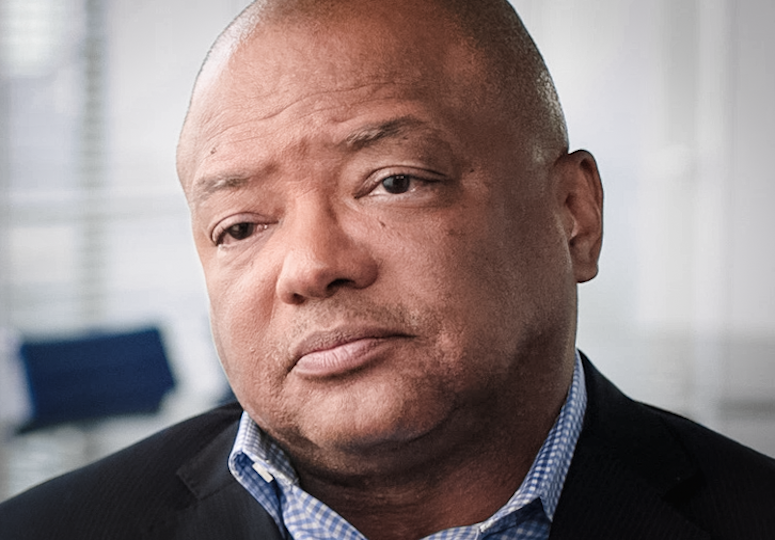
KEN FRAZIER
INTERVIEW ARCHIVE
Ken Frazier, Business Executive & Former CEO
September 16, 2024
Interviewed by: Kevin Maney
Total Running Time: 59 minutes and 15 seconds
START TC: 00:00:00
PRODUCTION
Good all around? Pardon my reach for a moment? Good on A&B. Rolling. Ken Frazier interview, take one, marker. Stand by one second for me Kevin to close this door.
00:15:23
ON SCREEN TEXT:
Ken Frazier
Business Executive and Former CEO
00:00:15
KEVIN MANEY
Okay. Let me know when to go. Describe for me what the house was like where you were born and grew up.
00:00:23
KEN FRAZIER
So, I was born and raised in Philadelphia, more specifically in North Philadelphia, which is the inner city. When I grew up, people referred to it as the ghetto in Philadelphia. But by accident of geography, I was actually born in my father's house, which was in North Philly, but it was a whole different experience growing up in my parents' house. I say my father usually, because my mother died when I was 12 years old. But my household was a, was a household full of books. My mother was a musician. My younger sister grew up to be a concert musician, won a Grammy. And so, the house was full of literature, and it was full of music, it was full of discussions about the contemporary issues of the time, which were essentially the civil rights movement.
00:01:17
KEVIN MANEY
Talk about your father, because it sounds like your father was a huge influence on you, and he was... His profession was not one that would suggest your house was full of...
00:01:26
KEN FRAZIER
No, no. So, so let me tell you a little bit about my father and then also my grandfather, my paternal grandfather. So, my paternal grandfather, Richard Frazier, was born in 1857, was born into slavery. My father, Otis Frazier, was born in 1900. So, I'm only the second-generation post-slavery and on my father's side of the family. My father grew up in South Carolina. He had only three years of what passed for a public-school education for a Black child in the early 20th century in South Carolina. But that doesn't tell you at all who he was because he was determined to be all the things that society said he couldn't be. So, he was self-taught, he read two newspapers a day. We all joked when we went away to college, we would drop off last semester's book, and he would want to talk about whatever you took in the last semester because he had this thirst for knowledge.
00:02:27
KEN FRAZIER
I often say that I believe my father was one of the most meritorious human beings I ever knew, given where he came from and who he became. And everything about my life is the result of his belief in this country and what could be achieved. Sometimes I think to myself, whether I'm in the Vatican speaking to the Pope or in the White House speaking to the president, the only place in the universe that that possibility existed in 1967-68, pick a year, was in my father's head. And it only happened because he insisted not only that it could happen, but that it should happen.
00:03:07
KEVIN MANEY
And he obviously imparted that on you, that you could be whatever you wanted to be.
00:03:13
KEN FRAZIER Absolutely, not only could you be it, but you had an obligation to be it. His view of the world was there's this narrative... He always felt very, very grateful to his father, who was, again, was a sharecropper, but was born into slavery on the same plantation. My father spent his life asking himself one question, and it was, what caused his father, my grandfather, to send my father North before he reached the age of majority, so that my father didn't become indebted to the land and become a sharecropper? And my father was a religious man, and so he would say, this man, my father, Richard Frazier, had no context to think about the future, except that he knew something was better than what he had. And so, for us growing up, we felt the obligation to do something because of that narrative. To move one step further beyond where my father was because of the fact that my grandfather made my father's life possible.
00:04:21
KEVIN MANEY
Now, there was a little tidbit that I read somewhere about you that I thought I'd like you to talk about because it seemed to say a lot about what the household was like and what your.... About your enduring memory of your father has something to do with the smell of this shaving cream.
00:04:39
KEN FRAZIER
So, I think it's really important for children to grow up in a house where they see their parents having responsibility and taking an important role in the world. Although my father was only a janitor, he had what most people would consider a menial job, I always say to people that one of the most enduring memories I have of my childhood was following my father into the bathroom in our little modest house. We only had one bathroom for my entire family. And because I was bussed across town to go to school, I got up a little earlier than my next oldest sibling who went to the neighborhood school. So, that all meant that I followed my dad into the bathroom every morning. And one of the enduring memories of my life was the smell of my father's shaving cream every morning because that was a reflection of the fact that he got up every morning, he shaved, he dressed, he went down those stairs, he went to work, he took care of his family, and that was my image of what it meant to be a responsible adult.
00:05:48
KEVIN MANEY
Do you remember what brand shaving cream it was?
00:05:51
KEN FRAZIER
Actually, I do. I think it was an Old Spice shaving cream.
00:05:54
KEVIN MANEY
Yeah, so anytime you smell that, it takes you right back there.
00:05:58
KEN FRAZIER
Absolutely.
00:06:00
KEVIN MANEY
So, about your mother. So, first of all, tell me about her, but also, I have to tell you, like, as someone else who lost a parent young, I know that has an enormous effect...
00:06:09
KEN FRAZIER
Right.
00:06:10
KEVIN MANEY
...on you and how you think about life. So, tell me about her and then what happened when she died and how that affected you.
00:06:17
KEN FRAZIER
So, my mother and father were an interesting couple in the sense that I was born, my father was 55 years of age, my mother was his second wife, his child bride, so to speak, and then she died at age 40. So, he would have been 65 at that stage. My mother was a musician, she was a church organist, but was classically trained and was, you know, again, one of these people who was very much involved in her community. She wrote for the local Black newspaper in Philadelphia, the Philadelphia Tribune. And so, you know, she was, I would say, a person who was worldly, as much as you could be in the 60s, given the constraints that were placed on people. So, one of the stories that I sometimes reflect on was, when I was a little kid, maybe around 10 years old, one morning, we all gathered up in the summer.
00:07:19
KEN FRAZIER
My mother grabbed all my siblings, and we got on the train, and we went to New York. And we didn't really know why we were going to New York on that particular day. It was kind of a rush. As it turns out, Ralph Bunch, who was the U.S. Representative in the United Nations, was presiding over the General Assembly that day. And to her, it was important for her to take her children to see Ralph Bunch, who was an African American, preside over the U.N. I think she thought that was something important. The other story I remember about her, right before she died, is she made sure that we all went to Marian Anderson's final concert which took place in Philadelphia, Marian Anderson being a Philadelphian, because again, she thought somehow that would impact our way of thinking of ourselves.
00:08:08
KEVIN MANEY
And by the way, did you inherit any of that musical talent?
00:08:11
KEN FRAZIER
None whatsoever.
00:08:17
KEVIN MANEY
So, you were twelve when she died?
00:08:18
KEN FRAZIER
Yes.
00:08:19
KEVIN MANEY
What in fact did that have on the way you thought about life even to this day?
00:08:25
KEN FRAZIER
Well, when a child loses a parent, especially in our case, my mother went in to have a hysterectomy, so we didn't expect that she wouldn't come home. It was an elective surgery. It was something that was commonly done for women at that particular age, and when she passed away, it was a real shock to us. I would say a couple things about that. First of all, in the mid-60s, I don't think it was unusual, certainly in my house, for my parents to have very different parenting roles. When my mother died, it was the loss of the parent that was the nurturing parent. My dad worked hard, he was a very severe, strict, unsentimental man. And so, my mother died, and we were left with my dad, so to speak. I guess, I would say, the strongest memory about this that I have is that when she passed away, of course, the house is full of people, and they bring food and flowers and there's a lot of attention placed on the family when you have a loss like that.
00:09:24
KEN FRAZIER
But after she was buried, I remember that night we all came home and the house emptied out and it was just the three of us, the kids and my father. And my father did two things that evening that I, now that I'm grown, I think were really remarkable for a man who had no sort of nurturing background, who had lost his young wife and had three very young children. The first thing he did is he gathers us all up and we all sat in the living room; he was giving us a pep talk. And part of that pep-talk, he said, you know, today was a good day, kids, because your mother won't suffer anymore. She'll be with the Lord. Which really was an incredible thing for a man to say, who had undergone that kind of sudden loss and had that kind responsibility. The next thing he did was he said, what do we watch on television?
00:10:25
KEN FRAZIER
And I don't remember exactly what we watched. It might have been Batman or Rowan & Martin's Laugh-In. I don't know what it was. But that was his way of saying, things are going to be normal for us. Because my dad would never have asked that question, nor would he have ever joined us in watching a television show. So those are my two memories. It was a sudden loss, but it really reflected my parents' very strong union and their commitment to their children.
00:10:55
KEVIN MANEY
That's amazing, yeah. So, in passing, a bit before, you mentioned about being bussed to another school, and I think you said before that that was one of the most important things that happened to you.
00:11:08
KEN FRAZIER
It's probably the most significant thing that happened to me early in my life. Being raised in the inner city, the local schools, the neighborhood schools, were not very good schools. And then after third grade, I was bussed across town to different schools, which I believe were the most significant events in terms of my own opportunity, expanding my own educational opportunity. You know, I think it's unfortunate, not to be preachy about this, but we live in a country where often, as it relates to public education, the quality of a child's educational experience is often related to whether his or her parents can afford real estate that's proximate to where the good schools are. Well, my parents couldn't afford real estate that was proximate to where the schools were in Philadelphia, but the social engineers, whoever they were, in the mid-1960s thought that they would engage in what they called school desegregation,
00:12:10
KEN FRAZIER
which is different from integration. It's this concept that a few little Black children should be given an opportunity to get on a bus and go across town, be strangers in a strange land, but be given in education that they otherwise wouldn't be given. And I wouldn't be here today, I'm quite sure, but for that, that opportunity.
00:12:32
KEVIN MANEY
And then you graduated at 16.
00:12:36
KEN FRAZIER
One little funny story about that. I was actually supposed to go to the United States Military Academy at West Point. My local congressman had been waiting to exercise his appointment. In those days, there was an appointment system, but you had to have the grades, and you had to have the, you know, the LSAT, I mean the SAT scores as well as the, you know, national merit exam. And so, I was a pretty good student, and he learned about me, and he came and he sat in my father's house and explained to my father that this would be the greatest honor that my family could ever have. Now, there was a war going on at the time and I wasn't particularly interested in going to the military academy or the naval academy. Anyway, I was admitted and I think it was around Thanksgiving of that year. We got a letter from the commandant at West Point, it said. Dear Mr. Frazier, upon close review of your record, we have now discovered that you are 15 years old and you can't be inducted into the Army.
00:13:38
KEN FRAZIER
We'd like you to go to one of these Army finishing schools, a military academy, for two years. That was my opening with my dad to say, notwithstanding the fact that our congressman thinks this is a great honor for our family, should I have to wait two more years to go to college? And he agreed that that wasn't necessary.
00:14:00
KEVIN MANEY
So, did you just skip some grades in there?
00:14:02
KEN FRAZIER
Yes, I skipped two grades.
00:14:06
KEVIN MANEY
So, I want to dial back a little bit, because you talked about that you grew up in an atmosphere when you were discussing civil rights and civil rights movement, and I think you also said that one of your heroes was Thurgood Marshall. How involved were you? How aware were you of all of that, and what was your... Did you get involved much?
00:14:26
KEN FRAZIER
No, when I was a child, I wasn't very involved, other than that, you know, the dinnertime conversation at my mother and father's table was always about topics. In fact, I remember one exchange when I was very, very young. One of the neighboring... I was in one of the neighboring houses, and when I came home, the mother of that family walked me home and she said to my mother, you know, Kenny talks like a grown-up, right? And she says something to the fact of, you know, aren't you going to let them be kids? And my mother said, they already know how to be children, I'm trying to teach them how to be grown-ups. So, my point is that the conversation, the dinner conversation, was always about what was happening in the world. It was always what was happening in the newspaper. And so, I felt very fortunate to grow up in a house where...
00:15:27
KEN FRAZIER
I became a lawyer, but a lot of it was because of the conversations that were happening around me. And so, I was aware of the civil rights movement. Probably when I was growing up, more aware of Martin Luther King and the freedom movement that was always in the newspapers. But I was also very much aware of the legal battles that were being fought in the courts led by Thurgood Marshall. I think of myself, I say I'm a Brown baby. And I don't mean that simply by virtue of my complexion. I say that because I was born in the months immediately after Brown versus Board of Education was decided in 1954. And so, coming back to being bused to a better school, that's all a result of the fact that there were a courageous group of Black, largely Black, lawyers who challenged, constitutionally, the system in this country, in which race was a disadvantage, and said at the end of the day, children should grow up and be able to reach their full potential. So, Thurgood Marshall was a hero of mine. It was a long-winded way of saying that.
00:16:35
KEVIN MANEY
So, how early in life did you decide you wanted to be a lawyer or go to law school?
00:16:39
KEN FRAZIER
Well, I remember when I was graduating high school and going off to college. I was torn because I was really interested in science. And I took AP science courses and chemistry and physics and math courses. And so, when I went away to college at Penn State, I was initially a chemistry major because that was a follow on to what I was doing in high school. But I also was very interested in law. And interested in sort of politics. So, after my freshman year, I decided I was gonna veer away from being a chemist. I was a chemistry major and focused on pre-law. And so that was where I went. Interestingly enough, I became the CEO, many years later, of a company that's, in essence, a chemistry company.
00:17:34
KEVIN MANEY
That's true. So, I just want to go... So, you went to Penn State.
00:17:41
KEN FRAZIER
Yes.
00:17:42
KEVIN MANEY
And so, you arrive, you're 16 years old, you arrive at college. Yes. So, what was that like? How did you navigate? I knew I couldn't have handled college at 16.
00:17:52
KEN FRAZIER
Well, you know, I think, going back, when you lose a parent as young as I do, as I did, it forces a level of maturity on you because my dad had to go to work every day and we had to be responsible for ourselves. So, when I think about college, and I hope I don't sound obnoxious in saying this, I was the youngest, but I was one of the most mature of the kids on campus because I had taken that responsibility for myself. Now, that didn't mean that the girls wanted to date somebody who was that much younger. That was an issue. But, in terms of focusing on schoolwork and all of those things, I basically had learned to take care of myself at a much younger age.
00:18:39
KEVIN MANEY
Were you, as a student, one of those very focused on school or did you get involved in other things in college? Sports, clubs, what else did you like to do?
00:18:47
KEN FRAZIER
Well, intramural sports were a big deal, but I was very much focused, from the time I went to law school, excuse me, to college, I was very focused on where I was going to go to law school. I remember going to the library and reading the catalogs for all the good law schools and realizing that you had to have a really good GPA and a really good LSAT score, and so I was very focused on that. My goal was to go to Harvard or Yale.
00:19:13
KEVIN MANEY
So, you set that as a goal.
00:19:15
KEN FRAZIER
Yes, conscious goal.
00:19:16
KEVIN MANEY
Conscious goal. And so, you got into Harvard Law School. Talk about that. What was it like to go, what did you like about law school? What did you not like about law school?
00:19:29
KEN FRAZIER
Arriving at Harvard Law School in 1975, I think, was probably one of the most challenging experiences in my life because you know when I went to Penn State there were a lot of first-generation college students. I remember when I arrived at Harvard the challenge around Harvard was one of social class. For the first time in my life, I was around a lot of people who were from a higher social economic class. And I didn't feel like I was incapable of working hard and achieving, that wasn't the issue. But I felt very much, as a kid coming out of the inner city, my dress, those kinds of things, I felt like I wasn't in the mainstream at Harvard Law School. And that was tough for a while.
00:20:23
KEVIN MANEY
And how did you, like, how did you deal with it? Did you try to fit in? Did you just not worry about it? How does, how does one kind of deal with things like that?
00:20:31
KEN FRAZIER
Well, a little bit of both. Sometimes I tell a story about my dad, who is, again, I said earlier, my father wasn't a very sentimental person. But early in my life, he gave me some of the best advice that I have ever been given. When I was about 13, 14 years old and felt like I wasn't fitting in in my neighborhood because I didn't have the right kind of sneakers and things of that nature. But my father said to me, he said, Kenny, what other people think about you is none of your damn business. And the sooner you learn that the better off you'll be. And so, I remember feeling inadequate at times, feeling like I wasn't the equal of people. But at the same time, I knew that I was there to study and that I could hold my own academically with people. So socially, it was a challenge. Academically, it was not a chip, which is what I'm saying.
00:21:31
KEVIN MANEY
Whether Penn State or Harvard, did you have any professors that were a huge influence on you?
00:21:38
KEN FRAZIER
I would say at law school, not so much. Undergraduate school, I had good professors in undergraduate school, obviously. But I think I had a couple of law professors, and one in particular, Derrick Bell, who was a really good African American professor. And I wanted to be a civil rights lawyer. Again, going back to Thurgood Marshall, my conception of what it meant to be a lawyer was to be like Thurgood Marshall. And I remember having a meeting with Professor Bell. And he said something that was kind of prescient. I didn't know it at the time. He said, we need third good marshals in the boardroom, not just in the courtroom. And he was a very good mentor of mine. A lot of law professors were good mentors of mine. My first semester, it was a professor named Katz, who's now dead. But I remember early on, my first set of exams, he gave me a really high grade in his class, and he called me in.
00:22:40
KEN FRAZIER
And I guess in retrospect, I should have been a little bit offended by the way in which he expressed surprise, pleasant surprise, that I had done as well, but he said to me you're gonna be a really good lawyer and don't let anybody tell you otherwise.
00:22:56
KEVIN MANEY
That's great. Your wife, Andrea. When and how did you meet her?
00:23:03
KEN FRAZIER
So, we met after I had become a partner in a Philadelphia law firm. So, we're skipping ahead a lot of years in the law practice. She was the placement director at NYU Law School, not far from where we are today. And we met at a social event in Philadelphia with a large Philadelphia law firm, it's a prestigious Philadelphia law firm, through a cocktail party for the placement people in the top law schools trying to curry favor so that we get the best students. And I met her at that cocktail party, and we were married six months later.
00:23:39
KEVIN MANEY
Wow. And what about or struck you right away?
00:23:42
KEN FRAZIER
Well, I think a couple of things. So first of all, she was a beautiful woman. And then secondly, as I got to know her, I realized that her family was very reminiscent of the house that I grew up in. She had two parents, but the values they had, her worldview, were consistent and consonant with mine. And so that worked out well. The other thing is, I look back at this and I, you know, I realized that when I first went to practice law in this large law firm, I was very dedicated and committed to making partner. And I think it might have been a relevant factor, although not a conscious factor, that I had already made partner. And I met her after I had achieved that goal.
00:24:36
KEVIN MANEY
My understanding from little things that I read is that she's also maybe been very good at puncturing your ego once in a while.
00:24:45
KEN FRAZIER
Yes, she has.
00:24:45
KEVIN MANEY
Tell me about that.
00:24:48
KEN FRAZIER
Well, she likes to make fun of me by saying that I need to be for, what she likes to call, chronic high self-esteem. She says, you know, you need to talk to some kind of therapist to work on your high self-esteem. One of the things that I'll never forget is that one evening I was being honored at one of these fundraisers. And so, you have to stand up and give this talk. And I said something about, you know, how honored I was to get this award. I think it was from the Legal Defense Fund, going back to Thurgood Marshall, the NAACP Legal Defense Fund had given me an award for having done death penalty work and things of that nature. And we were in a car coming back, and she said to me, you know, when you said that you were humbled to get the award, she said, you're not nearly great enough to pretend to be humble. So, knock it off.
00:25:43
KEVIN MANEY
That's great, it tells you a lot about your interactions.
00:25:48
KEN FRAZIER
Well, she's in charge.
00:25:52
KEVIN MANEY
Tell me about the law firm. How did you end up there? What was the firm? What was it like?
00:25:59
KEN FRAZIER
So, that was another big social adjustment in my life. You know, in our society, we have lots of ways in which people are divided, and race is a significant one. But one that I think, often, people don't talk about is sort of social class. And so, when I graduated Harvard Law School and went to practice law in the law firm of drinker Biddle and Reath in Philadelphia, the name even gives you a sense of how WASP-y it was. I got to understand the importance of social class. So, everyone, not everyone, but almost everyone had gone to the same prep schools. People would say to me, where did you prep? And I thought they were asking me, you know, did I get a haircut or something like that. But they had all gone to private schools. What was called the social register, which was the book that actually all the prominent families were listed in, was a reference book in the library.
00:27:01
KEN FRAZIER
So, when I went to that law firm, I had to make a big adjustment coming from the inner city to being in one of the top law firms in Philadelphia, because the clients were, of course, from the manor born. And I was not from that place. And it was really, for me, a very big adjustment. But again, I never felt like I couldn't do the work. I always felt like I was going to be a good lawyer. And very early on in my practice, I tried a case, actually, for Merck. At the end of my first year, which was unheard of in a large firm, for a first-year lawyer to actually go into federal court and to try a jury trial, I asked for the opportunity. The senior partner in the case gave me that opportunity with the consent of the Merck general counsel because it wasn't a lot of money, but it was an important case.
00:27:59
KEN FRAZIER
And I think I learned from that case that what I thought I was going to be good at was jury trial work. And in large law firms, there are lots of lawyers, including a lot of them who have litigation practices, but very few of them actually are willing to stand up and try cases to juries. And that was something that I found that I was very good at. And if I could go back to my upbringing, I believe it had to do with my upbringing. I talked about my father having very little in the way of formal education but being a brilliant person. And so, I think I always had the ability to communicate with juries because I was basically from where they were from, but I had been given this educational opportunity. And years later, I realized that many of my partners really didn't understand how to communicate with the normal, average American citizen.
00:29:03
KEVIN MANEY
Specifically, what was that case, actually, the Merck case that you tried at first, that gave you a break?
00:29:09
KEN FRAZIER
So, it was a very interesting case. It had to do... At that time, Merck was a conglomerate of a lot of different businesses. Now, it's strictly a pharmaceutical and vaccine company. Back then, Merck, though, like many companies in the 70s, had lots of different businesses. And one of the businesses that was under the Merck umbrella was a business called Baltimore Air Coil. They're still one of the largest manufacturers of these large cooling towers you see on top of office buildings. And so, the case had to do with one of those huge cooling towers, which was being shipped from New Jersey to South America. And during the voyage, one of the sailors happened to fall through the packing crate and get injured. So, it was an injury on the high seas, it was sort of what was called an Admiralty or Maritime case. It didn't involve as much money because it was really around that person's injuries, but it was tried in federal court.
00:30:08
KEN FRAZIER
And again, I asked for the opportunity to try the case. If I could just take a minute, I was the youngest lawyer. There were two partners in the room who were senior to me, and then these senior partners. So, there were three partners plus me as the junior guy. So, I was supposed to do the kind of basic stuff in the case. And we were sitting around preparing for trial on a Friday afternoon. I remember I said out loud, I said, I wish I could try this case. And the two intermediate partners yucked it up like ha ha ha, right. But the senior partner didn't laugh and as I was gathering my stuff up the other two left and he said to me, Kenny— they called me Kenny because I practiced law in the city that I grew up in, so I still have my childhood nickname— he said I'd like you to go home this weekend, come back Monday morning and tell me how you would open to the jury. So, that whole weekend I spent focusing on that. No dates, no social stuff.
00:31:09
KEN FRAZIER
The morning I came in, and I said to this partner, his name is Bob Ryan, he's long dead now. I said, this is how I would explain the case and open to the jury. He then got on the telephone with the general counsel of Merck, a guy named Bob Vance, also who's dead now, who was a great mentor of mine. And I'll never forget the conversation he said, you know, they had those old-fashioned cradle speaker phones, so I could hear the conversation between the partner and the general counsel. And he said, I've got this young feller here — not fellow, feller, he said — I've got this young feller here who really wants to try this case and the general council so well, let the young feller have a chance, it's not that much money. And so, to the surprise of the partners who were on the case, I was given the opportunity to go with one of the partners as kind of a safety valve in case I completely crashed and burned to try the case. And we tried the case, and we won.
00:32:09
KEN FRAZIER
And after that, the general counsel of Merck made sure that as I got more and more senior, that I got really good work from Merck, because, you know, experience and practice is the stock and trade of lawyers. And so, I was given the best opportunities that Merck could afford in terms of cases. And eventually, one day I became the general counsel of Merck. But that's a long time in the future.
00:32:38
KEVIN MANEY
Well, tell me about that. So, obviously, there's a straight line between this big break and eventually joining Merck. How did that happen? How did Merck approach you about actually joining as the general counsel?
00:32:52
KEN FRAZIER
So, this particular person, Bob Vance, had stepped down, and his successor, Mary MacDonald, had taken over. And the first thing she was thinking about, one of the first things she was thinking about is who's gonna become her successor. And by that time, I had become a partner, and I was frankly Merck's go-to outside trial lawyer all over the United States. They would bring me into trial cases all over in the United States. So, I had a pretty good reputation in the Merck Legal Department. And I was known to the CEO of Merck, too. And so, they sort of got together and they said, let's invite Ken to come in to be the eventual general counsel. So, they invited me to lunch, and I talked to them. And I came home, and I said to my wife, I said, oh, this is such a great honor, but I don't really want to go and be a lawyer in a company because, actually, I had a terrific practice. You know, trial work is exciting work. Sometimes I say to people...
00:33:51
KEN FRAZIER
People say you're a lawyer, I say, when you watch television, when television lacks imagination, they make shows about firefighters, police officers, emergency room physicians, and courtroom lawyers. And the courtroom is a great place to make a living, trying cases to jury, especially when the stakes are high— I had the opportunity to try death penalty cases— those are great opportunities, and I couldn't imagine going from the courtroom to sitting in some office in a company and doing business law stuff, but my wife, who once again is the smarter of the two of us, had at that point left NYU Law School and become a legal headhunter. And so, she was looking at the practice of law from the standpoint of business. And she said to me, you know, being a partner in a law firm is nice, sweetie, but I don't wanna tell you how to run your business,
00:34:51
KEN FRAZIER
but in some ways, it's a cruel hoax because I don't think younger people will work as hard for you as you worked for the senior partners when you were a junior person. And she says, you there's this thing called stock options that they have in corporations. And so, if a company like Merck, which was at that time, the most admired company in the Fortune survey for like seven or eight straight years, offers you this opportunity, you ought to go. And so, I listened to her, and I went.
00:35:19
KEVIN MANEY
What year was that and how old were you at the time?
00:35:21
KEN FRAZIER
It was 1992, when I was 37.
00:35:27
KEVIN MANEY
And who was the CEO at the time.
00:35:29
KEN FRAZIER
His name was Roy Vagelos, Dr. Roy Vagelos.
00:35:33
KEVIN MANEY
And my understanding is that Dr. Vagelos was a huge influence on you.
00:35:38
KEN FRAZIER
Absolutely.
00:35:40
KEVIN MANEY
Talk about Roy.
00:35:40
KEN FRAZIER
Absolutely. So, I talked about how the general counsel gave me the opportunity to do successively more important cases and how that was important to me. I joined the company as a lawyer and shortly thereafter, after I arrived, they did a bait and switch. Dr. Vagelos called me into his office and said, you know, I know we hired you to one day be general counsel, but McDonald isn't going to retire for another six years. And I don't want you to be sitting under her. We know you're a lawyer. We won't forget that you're a lawyer. I want you to learn the business. So, he gave me a responsibility in the business that I didn't actually want because I knew I was a lawyer, frankly, I don't wanna be boastful, but I know I was a really good lawyer. And to be forced into the business was to be forced into an area where I didn't really have the same chops. So, I went back to him, and I said, I'd like to contribute to Merck in my own discipline, meaning the law.
00:36:40
KEN FRAZIER
And he said, that's the most ridiculous thing I've ever heard in my life. I'm giving you an opportunity to learn our business. And so, I took his, I took a suggestion, and I went into the business and I was there 31 years. And when I look back on my 31 years, only six or seven were in the legal department. But that's because he gave me these broader opportunities that I would never have thought of. In fact, I would have never become CEO if, for my first three years, I didn't work directly for him.
00:37:12
KEVIN MANEY
What else did you learn from?
00:37:14
KEN FRAZIER
Well, I learned that a company like Merck is more important than just a vehicle for creating wealth for shareholders. I learned the significance of a company like Merk and its role in alleviating human suffering, in improving and extending human lives all over the world. And so, I learned, what I would say, the purpose, the fundamental purpose and values of the company, which I knew anyway, by the way. I shouldn't say I learned it. But I learned it in a different way sitting right next to the CEO, because one of my first responsibilities was to communicate on his behalf. So, I would be putting into words, into written documents his views on the world, on health around the world. His views on his role in the pharmaceutical industry, the role of Merck. And there was no better preparation for one day being the CEO of that company.
00:38:11
KEVIN MANEY
And Merck has a very strong culture and ethos, can you talk a little about that and why that resonated with you?
00:38:21
KEN FRAZIER
Well, I talked about doing death penalty work. And I spent, for example, on one case about six years to exonerate a person who was 13 days away from his execution date. So, you would spend six years of your life trying to save one person's life. The ethos of Merck, the purpose of Merck, is again to save lives, but on a grand scale. And so, when you really think about what the company exists to do, I thought of it as an extension of the work that I was doing, for example, for people under sentence of death. But I also have to say, you know, being a person who was raised in the church and in the Christian faith, healing the sick was something that we ascribe to the master, to Jesus Christ. And I don't wanna be, I'm not trying to be a proselytizer here, but healing the sick was something that I thought was kind of a sacred cause.
00:39:20
KEN FRAZIER
And, when you're in a company like that and you travel around the world, you travel to places in the world where people live incredibly harsh lives, suffer from grievous illnesses because they're poor or they don't have access to medicines and you see what medicines and vaccines do, there's nothing like it. I wouldn't work for any other company. It's interesting because the outside world thinks so poorly of the pharmaceutical industry, and yet when you're in there and you're surrounded by these physician scientists who are doing great things... I'll boast, when I was a CEO, one of my colleagues, Bill Campbell, won the Nobel Prize. So, how can you not love working for a company where a colleague wins the Nobel Prize? And you know, it's not like the Nobel committee is going out of its way to recognize pharmaceutical researchers.
00:40:21
KEVIN MANEY
Well, so another aspect of Merck that I know about is its commitment to science and research. And my understanding is that in the face of pressure from Wall Street, soon after you became CEO, you defended that for Merck. And can you talk about that and how you wouldn't... I think there was one point where you wouldn't... You cut earnings estimates so you could actually continue to fund R&D.
00:40:47
KEN FRAZIER
So, again, I go back to saying, having worked for Dr. Roy Vagelos for my first three years oriented me to what was really important about Merck. And the most important things about Merk, in my view, don't change, and they never should change. And one of those things is that commitment to doing cutting edge research, pushing in the scientific envelope. When I became CEO, it was fashionable on Wall Street to say that pharmaceutical CEOs ought to cut their R&D budget and, in fact, invest in non-pharmaceutical assets. That was kind of common. There was a company called Valiant that was the top performer from a stock standpoint and their whole approach was they didn't do any R&D. They bought smaller companies, took the drugs, jacked up the price, took no scientific risk, and that was... Shareholders love it because, you know, no risk and high return.
00:41:49
KEN FRAZIER
What's not to love about it? Of course, until that preferred perpetual motion machine runs out of energy, and they are gone now. But the reality of the world is, that was what people thought. And when I became CEO Merck had given five-year guidance in terms of earnings-per-share growth, of which three years remained when I took over. And when I looked at our budget and I looked what was the implication of that roadmap, if I can call it that, that earnings roadmap, it was clear to me that if we were going to stay on that earnings pathway, that I would have to do fairly large, and I felt indiscriminate, cuts in the research and development organization, which I was unwilling to do because that's sort of the fundamental purpose of Merck. So, it wasn't a fun time because I was a brand-new CEO, I was 25 days into my job when I called a special board meeting to tell them that I had made this decision and I can tell you,
00:42:50
KEN FRAZIER
my board was not happy. In fact, I remember the lead director saying, we won't let you do that. And I said to him, Bill, I'm not sure what you think you just said to me, but I called this meeting to say I don't intend to walk away from our commitment to science, and stock went down. In retrospect, it was the best thing I could have done, first of all, because the people in our research organization knew that I was really committed to them. But at the same time, the other thing that I didn't know is that, you know, every time a share of stock in a company gets sold, of course, somebody buys it. And so, the shareholder base turned over, and the people who were buying the stock, albeit at a lower price, were people who believed in the research mission of the company. So, I had patient shareholders after.
00:43:41
KEVIN MANEY
Yeah, that's great. We definitely should talk about the whole Vioxx incident, because that's something that was very much, I think, a big part of your life and an important part of life. Talk about what happened and what role you played?
00:43:57
KEN FRAZIER
This goes back to Merck's values. Merck had a product called Vioxx, which was the best-selling painkiller in the world at that time— prescription painkillers, not like Tylenol or something like over the counter. It was the, the best-selling prescription painkiller and there were questions about its cardiovascular safety. Merck continued to do lots of studies to try to figure out whether there was, in fact, an issue with respect to safety. And after one result came back, the company voluntarily made the decision to withdraw the drug, which caused us to be sued 60,000 times, which was kind of existential. And I want to go back to something I said about being the son of a man who had no formal education and why that was so good for me as when I was doing jury trial work. At that time, people all thought that you couldn't try these cases to juries. It was the accepted wisdom that juries couldn't understand the science.
00:44:58
KEN FRAZIER
It was too complicated. And, of course, the plaintiff's bar advertises and gets thousands and thousands of these cases and then brings them to trial in places where defendants usually don't have a good record, they are places where the jury is, by and large, people who have no more than a high school education. And so, the common perspective was that we had to settle. I took the position that we were not going to settle and that we were going not to allow this to be dealt with as, in effect, a class action, but we were going to try each case one by one. And everybody was skeptical about that. And they were even more skeptical after our first verdict, which was $253 million against Merck. In fact, I remember on the front page of the New York Times, one of those analysis articles had some Wall Street person who said, the company was going to go bankrupt.
00:45:57
KEN FRAZIER
By the way, not a good word for your board to read in the Sunday New York Times on the front page. And they said they can blame it on the ineptitude of their lawyer, who insists on trying these cases. But, as it turns out, we tried 19 of those cases. When all the appeals were considered, we only lost three of the 19 and those three were very low dollar verdicts, which resulted in the plaintiff's bar coming to us and suing for peace at a number that was much less than Wall Street through. Wall Street thought it would be 40, 50 billion because there had been cases like the diet drug litigation and things like that that were precedent. We ended up settling for four billion dollars. Four billion dollars is real money but it's not 50 billion
00:46:52
KEVIN MANEY
Right, right. So, 2020 comes along, and you're the CEO of a pharmaceutical firm, a company, as COVID hits. What was that like?
00:47:03
KEN FRAZIER
Oh, very difficult. It was so... It was difficult in a couple of ways. So, first of all, Merck, like every other company, committed immediately to trying to develop a vaccine and therapy for COVID. We were not successful in our own research area. So that was, of course, painful to the pride of Merck as a company, although we did volunteer to manufacture for others just to make sure that we were able to help them. But it was really hard to run a company where people weren't coming to work. Now, let me drop a footnote. In a company like ours, because our medicines are essential to health, a lot of people in our company, the manufacturing and the research people, they had to come to work even in the worst times, when people didn't understand the disease, when we were still washing off our grocery bags because we didn't know how it was transmitted.
00:48:01
KEN FRAZIER
Those people had to come to work because we had to maintain the essential supply of drugs. Just because COVID was out there, didn't mean that somebody who was dying of cancer didn't need their cancer medication. We were essential, we had a bunch of our people who were essential employees, and they had to come in. And my secretary and I, we made the decision that we would come to work, because we thought it was really important for those people to see that the CEO didn't think he was more important than them. Our office-based people, they didn't come back to work. In fact, they're still, as in most companies, a lot of people who were working remotely on the office side. But it was a very difficult time trying to communicate globally to people when they weren't, sort of, in the same place. But we got through it.
00:49:02
KEVIN MANEY
Out of just curiosity, like, so why was Merck unable to be one of the ones that came up with the vaccine?
00:49:09
KEN FRAZIER
Vaccine research is vexing. It's hard. And the platforms that we use, which had recently been very successful in, for example, developing an Ebola vaccine, they just didn't produce the level of efficacy. They weren't total failures, but by the time the mRNA vaccines came out and had 95% efficacy, the efficacy levels that we reached were not competitive. But we were seeking a different kind of vaccine, to be honest, because those mRNA vaccines are great vaccines, but they don't have a lot of durability against infectious disease, which is why we keep doing the boosters. Merck sought to produce a vaccine that had broader impact across different kinds of the disease, but also, more importantly, was more durable. So, we failed at making a vaccine that sort of met the classic standards of a Merck vaccine.
00:50:12
KEN FRAZIER
Let's talk about measles, mumps, rubella vaccine. Children get it and they don't need a booster for 20 years. That's the classic definition of a vaccine. These vaccines, thank God we have the mRNA vaccines because we wouldn't be sitting here talking like this unless we had gotten that immunity, but Merck's attempt to produce the classic Merck version of a COVID vaccine did not get the level of efficacy that we wanted.
00:50:40
KEVIN MANEY
Fascinating, actually. Let's spin ahead a little bit more and so, you decide to retire. Why did you retire when you did? And then what did you decide to do afterwards?
00:50:55
KEN FRAZIER
So, I retired at age 68. We had mandatory retirement at 65. So, the board had asked me to spend three years past the mandatory retirement. And I retired when I did because, again, my spouse thought it was time for me to retire. And she, who must be obeyed, made it clear it was right time to do that. And also, as I said to my board when they were saying, stay around a little bit longer, I don't think it's fair to the company. In fact, I remember saying to them, I've been in this seat for 10 years now. Any ideas that I haven't had already are probably appropriate to classify as mischief. You know, you don't want the thing that I have not been able to think of in my first 10 years. And you also want someone who is younger, has a different perspective, a different set of skills. And so, I thought it was time to step down. And we have a great successor, Rob Davis, who's doing a terrific job in my place, you know?
00:51:55
KEN FRAZIER
And since I've retired, so to speak, because retirement is a bad word in my view, I've been working at General Catalyst, which is a venture fund, as chairman of Health Assurance there, and getting to know a different side of healthcare. They are very much committed to using technology to completely rethink how we do healthcare, to bring healthcare to people, better access, more affordable healthcare, you know, more innovative health care by collaborating with people who are traditionally in the health care field to improve how health care is delivered. So, I'm finding that to be fascinating and interesting. And then I'm doing a lot of things that are, I would say, that more public service things. I'm on the Harvard Corporation which is, I can tell you, a challenge today, given all that is happening in the world. I'm working on health in nutrition in Philadelphia. And along with Ken Chenault,
00:52:54
KEN FRAZIER
I am on the board of what's called OneTen, which is an organization that's a workforce development organization that was originally created to try to close the opportunity gap for Black talent. And so, we've now placed about 140,000 people, not all Black people, but many of them Black and brown people, into family-sustaining jobs, which means $50,000 a year or more, for people who don't have four-year degrees. Because that's a big issue in corporate America, is that many companies sort of reflexively require a four-year degree, even if the job doesn't really merit it. So, we're a skills-first hiring movement, is what we say.
00:53:34
KEVIN MANEY
Just to ask you one thing about the General... So, it's very unusual for somebody who's been CEO of a major company, Fortune 500 company for 10 years, to then join a venture capital firm. How did that happen?
00:53:50
KEN FRAZIER
Well, let me start by saying that I had a very good relationship with Ken Chenault. I've known him since law school, and he was a good mentor of mine when I moved over to the business side at Merck. And he plowed this path first. He went to General Catalyst, where he's chairman of the firm. And I was looking around for something to do, but I wanted it to be relevant, I wanted it to be important, and I wanted to have to do with health. And so, what General Catalyst does is it works on the startup side for these companies that are really trying to change how we do health through, you know, technology. The other thing was that when I got to meet other folks, including the CEO, Hemant Taneja, I realized that although they are a venture capital firm and although the outside world thinks of venture capitalists as people who are simply rapacious and trying to make a lot of money, they actually had the right values. So, I understood as a pharmaceutical person,
00:54:50
KEN FRAZIER
the outside world thinks all pharmaceutical people care about is profit. I know from being on the inside that people care a lot more, and that's what I learned about General Catalyst and that is why I made the decision to go there because I think they had the right mission and the right values.
00:55:06
KEVIN MANEY
Looking back on this conversation, you've done a lot of things, made a lot of decisions, it sounds like, that were maybe not the consensus or obvious choices. And I just wonder, how do you know when you're right? How do you know these are the right things to do?
00:55:23
KEN FRAZIER
What I would say about that is, a lot of it comes down to your own personal values. And, you know, I'll go back to my childhood and being raised the way I was, there's certain things that I strongly believe in. And I think the reason why issues become difficult for people to decide is they confuse the question of what's right for what will be accepted. And sometimes you just have to say, I'm willing to fail trying to do the right thing. I think a lot of people are afraid of failure. It's that simple. And I actually believe that if you're really going to be successful in a meaningful way, you have to risk that failure. And part of that is being willing to be unpopular.
00:56:18
KEVIN MANEY
Have any of these decisions backfired on you? Is there any point in time when you took that stance and it actually did fail?
00:56:28
KEN FRAZIER
Well, I talked about the first verdict in the Vioxx litigation. That felt like total failure. It was an N of 1. It was a catastrophe. When I say catastrophe, I mean front page of the New York Times at the top of 7 o'clock hour on the Today show explaining how you failed at it. But it wasn't really a failure in the sense that ultimately, we still had a chance to be successful. What happens is when you fail early at something, there's a tendency to say, how do I mitigate that? But if you try to mitigate it, you often don't get to the great success. So, Steve Jobs, to me, is a classic example of this. A man who was fired at Apple comes back to Apple and is the biggest success ever. That success arose from the ashes of failure. How you define success is important.
00:57:31
KEVIN MANEY
And there's a resilience in it, right? What gives you your resilience to go through those things?
00:57:39
KEN FRAZIER
I don't know where I learned the resilience, but I do pride myself in that word. I do believe that I have been resilient. I think my self-image of having grown up in a tough neighborhood and survived the toughness of that neighborhood, by the time I got to be a CEO, and you were worried about being criticized by Wall Street analysts. Or maybe, you know, I had one day stepped off the president's manufacturing council when President Trump was president, and you're being tweeted at by President Trump. That doesn't feel nearly as threatening as what you had to deal with growing up in that neighborhood. That's all I can say.
00:58:28
KEVIN MANEY
Well, let me finish by just asking about your family, too. I didn't ask at all about your kids or grandkids. Tell me about all of them and what they're doing and all that.
00:58:39
KEN FRAZIER
Well, I have two kids. My son, James is working in the fashion industry at a startup here in New York City. My daughter created her own startup company. She's a software engineer, and she's been very successful and just got married and lives out in the Castro Valley, San Francisco area, has her own company where she's done extremely well. So, they're doing well.
00:59:05
KEVIN MANEY
Great, wonderful.
END TC: 00:59:15